


 ABOUT BMA
 Bharat Aawaz
The Crumbling Pillar - Why the Decline of Indian Media is Every Citizen's Crisis
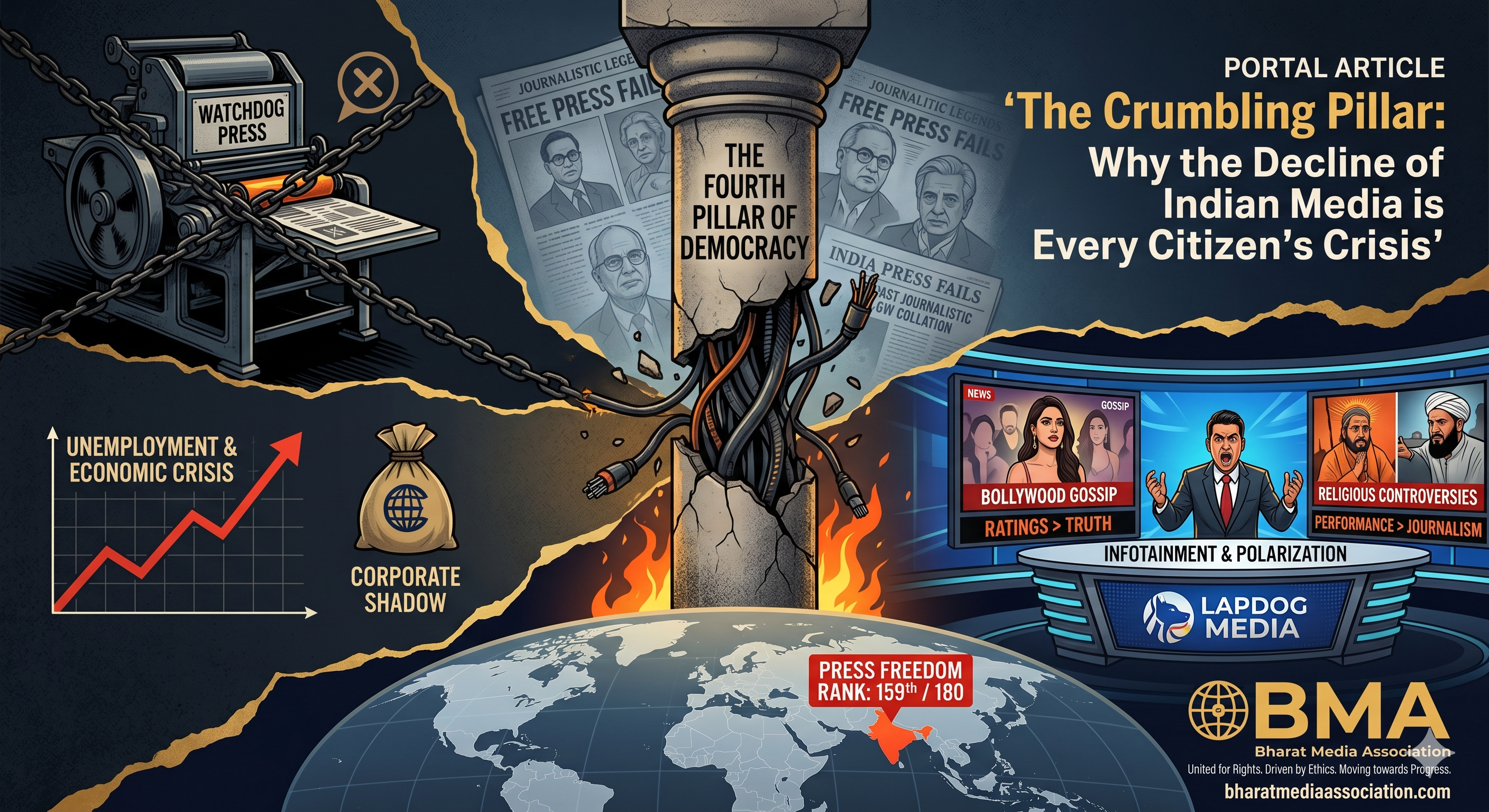
We need to talk about a crisis that affects every single citizen but is rarely reported: the state of Indian Media. What is the media actually reporting? More importantly, what are they choosing to ignore? And who are they really working for? As the self-proclaimed "Fourth Pillar" of democracy, has the media turned into a mere PR machine for corporate and political powers? An international critique recently highlighted the stark reality of how news is managed in India, and it’s time we look in the mirror.
The Missing Issues (Unemployment & Economy): Over the last 15 years, India has seen a massive surge in unemployment. Hundreds of thousands of graduates enter the workforce every year with no jobs in sight, leading to a mental health crisis and national stagnation. Yet, where are the debates on unemployment? Where is the scrutiny of price hikes? Fifteen years ago, an increase in petrol or essential food prices would lead to weeks of national coverage. Today, despite prices doubling or tripling, these issues have vanished from the headlines. The common man's struggle is no longer "news"—it's an inconvenience to the narrative.
The Corporate Shadow & The Global Perspective: Why this silence? Look at the ownership. Most major news outlets are now controlled by massive corporate entities—the Adanis, the Ambanis, and the Tatas. When billionaires decide what’s "important," the agenda shifts from profit protection to public welfare. They decide what stories live and what stories die. The result? A media that avoids questioning the system because they are the system. The world is watching. In a recent survey of 180 countries, India's Press Freedom rank plummeted to a shocking 159th position. To put that in perspective, countries like Afghanistan and Sri Lanka, despite their immense internal turmoil, are currently ranked higher in terms of press freedom. We have over 400 news channels, but not even 1% are dedicated to the actual problems facing the Indian people.
The visual landscape of reporting has also changed. Anchors no longer "inform"; they "perform." Studio theatrics, shouting matches, and high-octane drama have replaced actual debates. A recent study by News Laundry looked at a popular hour-long show on a leading channel and found that the anchor spoke for 41 minutes, leaving only 18 minutes for all other participants combined. It’s no longer a debate; it’s a monologue designed for ratings, not truth. While digital media is trying to show the "second side" of the coin, it faces its own battles against organized online mobs and funding issues. Mainstream media has become a global joke—a comedy show instead of a source of knowledge. If we want a healthy democracy, we need a healthy media. It’s time for the industry to change, and it’s time for us, the audience, to demand better.